Intestino
Seu intestino pode estar afetando muito mais do que sua digestão

Por que ele pode influenciar imunidade, inflamação, metabolismo e saúde emocional?
Muitas pessoas convivem diariamente com:
-
estufamento;
-
intestino preso;
-
ansiedade;
-
fadiga;
-
compulsão alimentar;
-
baixa imunidade;
-
dificuldade de concentração;
-
inflamação persistente;
-
sensação de corpo ‘pesado’.
Mesmo assim, os exames frequentemente parecem normais. Em muitos casos, o intestino pode estar participando silenciosamente desses desequilíbrios.
Durante muitos anos, o intestino foi visto apenas como um órgão digestivo responsável pela absorção de nutrientes e eliminação de resíduos. Hoje sabemos que essa visão é incompleta. A ciência moderna reconhece o intestino como um dos principais centros reguladores do organismo, com impacto direto sobre o sistema imunológico, o metabolismo, o cérebro, o equilíbrio hormonal e os processos inflamatórios.
Estudos recentes mostram que alterações da microbiota intestinal estão associadas a diversas condições clínicas, incluindo obesidade, resistência insulínica, doenças autoimunes, ansiedade, depressão, fadiga crônica e inflamação de baixo grau.Por isso, cuidar do intestino deixou de ser apenas uma estratégia digestiva. Tornou-se uma estratégia sistêmica de saúde.
Essa abordagem não substitui a medicina convencional. Pelo contrário: amplia a compreensão das causas dos sintomas e permite estratégias terapêuticas mais personalizadas e seguras.
Na medicina integrativa, o intestino não é tratado isoladamente. Ele é compreendido como parte de um sistema interconectado que envolve microbiota intestinal, eixo intestino-cérebro, permeabilidade intestinal, metabolismo energético, inflamação sistêmica e regulação neuroendócrina.
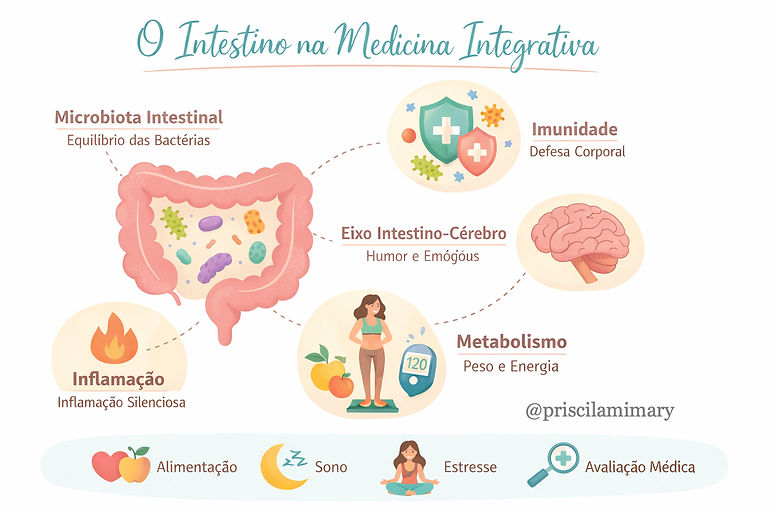
O intestino conversa silenciosamente com o cérebro, o metabolismo e a imunidade
Quando o intestino perde equilíbrio, diferentes sistemas do organismo podem ser afetados.
Na prática clínica, muitas pessoas chegam relatando estufamento, fadiga, ansiedade, compulsão alimentar e sensação persistente de inflamação mesmo após diversos exames aparentemente normais.
Uma avaliação integrativa pode ajudar a investigar possíveis fatores inflamatórios, metabólicos, hormonais e relacionados à microbiota.
O intestino e a Imunidade
Aproximadamente 70% das células do sistema imunológico estão localizadas no trato gastrointestinal. Essa concentração ocorre porque o intestino representa a principal interface entre o organismo e o ambiente externo. Todos os dias, o sistema digestivo entra em contato com:
-
alimentos
-
toxinas ambientais
-
microrganismos
-
metabólitos bacterianos
-
antígenos alimentares
Uma microbiota equilibrada contribui para:
-
regulação da resposta inflamatória
-
produção de anticorpos
-
proteção contra infecções
-
manutenção da barreira intestinal
Por outro lado, alterações intestinais podem estar associadas a maior suscetibilidade a infecções respiratórias e processos inflamatórios recorrentes.
É importante destacar que a modulação intestinal não substitui vacinas nem tratamentos médicos convencionais. Ela atua como estratégia complementar de suporte imunológico.
Para manter o equilíbrio, o organismo precisa distinguir substâncias seguras de ameaças potenciais. Essa função é realizada pelo sistema imune intestinal.
Quando esse sistema funciona adequadamente, ele promove tolerância imunológica. Quando ocorre disfunção, pode surgir inflamação sistêmica de baixo grau. Essa inflamação silenciosa está associada a:
-
fadiga persistente
-
dores musculares
-
queda de cabelo
-
alterações metabólicas
-
ansiedade somática
-
dificuldade de emagrecimento
-
alterações hormonais
A medicina integrativa considera esses sinais como possíveis manifestações de desequilíbrio intestinal.
O intestino e o Metabolismo
A microbiota intestinal influencia o metabolismo energético por diferentes mecanismos:
-
produção de ácidos graxos de cadeia curta
-
modulação da sensibilidade à insulina
-
regulação do armazenamento de gordura
-
interação com hormônios intestinais
Alterações nesses processos podem impactar:
-
ganho de peso
-
dificuldade de emagrecimento
-
compulsão alimentar
-
resistência insulínica
A medicina integrativa considera o intestino como um dos componentes do equilíbrio metabólico global.

O eixo intestino-cérebro
A comunicação entre intestino e cérebro ocorre por meio do chamado eixo intestino-cérebro. Esse sistema envolve:
-
nervo vago
-
citocinas inflamatórias
-
metabólitos bacterianos
-
hormônios intestinais
-
neurotransmissores
A microbiota intestinal participa da produção de substâncias como serotonina, dopamina e GABA. Alterações nesse eixo podem influenciar:
-
humor
-
sono
-
memória
-
atenção
-
resposta ao estresse
-
sensibilidade à dor
Estudos sugerem que alterações intestinais podem contribuir para sintomas emocionais mesmo quando exames laboratoriais estão normais.
Na medicina integrativa, essa relação é considerada durante a avaliação clínica de sintomas inespecíficos persistentes.

Intestino e inflamação
A inflamação intestinal de baixo grau pode ocorrer mesmo na ausência de doenças gastrointestinais clássicas. Esse processo pode estar associado a:
-
alimentação ultraprocessada
-
privação de sono
-
estresse crônico
-
sedentarismo
-
exposição ambiental
-
uso frequente de antibióticos
-
alterações hormonais
Quando persistente, essa inflamação pode contribuir para o aumento de citocinas pró-inflamatórias circulantes.Esse fenômeno tem sido relacionado a:
-
resistência insulínica
-
fadiga crônica
-
dificuldade de concentração
-
alterações metabólicas
-
maior risco cardiovascular
A abordagem integrativa busca identificar fatores contribuintes e promover estratégias de modulação inflamatória seguras.
Probióticos: benefícios e limites
Probióticos são microrganismos vivos que podem trazer benefícios quando administrados em quantidades adequadas. Estudos demonstram eficácia em:
-
síndrome do intestino irritável
-
diarreia associada a antibióticos
-
constipação funcional
-
algumas condições inflamatórias intestinais
Porém, nem todos os probióticos têm os mesmos efeitos. A escolha depende de:
-
cepa bacteriana
-
dose
-
tempo de uso
-
condição clínica
O uso indiscriminado pode não trazer benefício. Em pacientes imunossuprimidos, deve ser avaliado com cautela.

Prebióticos e fibras alimentares
Prebióticos são substratos utilizados seletivamente por microrganismos do organismo que conferem benefício à saúde, conforme a definição de consenso da International Scientific Association for Probiotics and Prebiotics (ISAPP).
Na prática, incluem determinadas fibras, como inulina, fruto-oligossacarídeos e galacto-oligossacarídeos, presentes em alimentos como cebola, alho, alho-poró, aveia, leguminosas e banana verde.
A fermentação dessas fibras no cólon produz ácidos graxos de cadeia curta, como o butirato, associados à integridade da barreira intestinal e à regulação da resposta inflamatória.
Nem toda fibra é prebiótica, e o aumento do consumo deve ser gradual, pois pode causar distensão abdominal, especialmente em pessoas com síndrome do intestino irritável.


Quando investigar o intestino de forma mais aprofundada
Alguns sinais indicam necessidade de avaliação médica para investigação:
-
dor abdominal persistente
-
alteração do hábito intestinal
-
perda de peso involuntária
-
sangramento digestivo
-
anemia
-
diarreia crônica
-
história familiar de doença intestinal
Nesses casos, exames específicos podem ser necessários.
Estratégias integrativas para o cuidado intestinal
A abordagem integrativa do intestino inclui intervenções baseadas em evidência científica e personalização clínica. Entre as principais estratégias estão:
-
alimentação rica em fibras
-
redução de ultraprocessados
-
sono adequado
-
atividade física regular
-
manejo do estresse
-
uso criterioso de probióticos quando indicados
-
correção de deficiências nutricionais
Essa abordagem pode contribuir para melhora da qualidade de vida quando aplicada com critério clínico e base científica.
Nenhuma dessas estratégias deve ser aplicada de forma padronizada sem avaliação médica.
Cada organismo responde de maneira diferente.
Como mostrado, quando o intestino perde equilíbrio, diferentes sistemas do organismo podem ser afetados, incluindo sono, imunidade, metabolismo e saúde emocional.
Uma avaliação integrativa pode ajudar a investigar possíveis fatores inflamatórios, metabólicos e relacionados à microbiota.
1. O intestino pode influenciar ansiedade? Sim. O eixo intestino-cérebro participa da regulação de neurotransmissores relacionados ao humor.
2. Probióticos funcionam para todas as pessoas? Não. A resposta depende da cepa utilizada e da condição clínica.
3. Intestino preso pode causar inflamação? Pode contribuir para desconforto e alterações metabólicas, mas deve ser avaliado individualmente.
4. Existe exame para avaliar microbiota intestinal? Alguns testes existem, porém nem todos têm aplicação clínica validada.
5. Alimentação influencia a microbiota? Sim. A dieta é um dos principais moduladores da microbiota intestinal.
FAQ - Perguntas mais frequentes
REFERÊNCIAS:
MAYER, E. A. et al. Gut-brain axis and the microbiota. The Journal of Clinical Investigation, v. 125, n. 3, p. 926-938, 2015. DOI: 10.1172/JCI76304.
CARABOTTI, M. et al. The gut-brain axis: interactions between enteric microbiota, central and enteric nervous systems. Annals of Gastroenterology, v. 28, n. 2, p. 203-209, 2015. PMID: 25830558; PMCID: PMC4367209. Errata publicada em: Annals of Gastroenterology, v. 29, n. 2, p. 240, 2016.
CRYAN, J. F. et al. The microbiota-gut-brain axis. Physiological Reviews, v. 99, n. 4, p. 1877-2013, 2019. DOI: 10.1152/physrev.00018.2018.
VALLES-COLOMER, M. et al. The neuroactive potential of the human gut microbiota in quality of life and depression. Nature Microbiology, v. 4, p. 623-632, 2019. DOI: 10.1038/s41564-018-0337-x.
APPLETON, J. The gut-brain axis: influence of microbiota on mood and mental health. Integrative Medicine (Encinitas), v. 17, n. 4, p. 28-32, 2018. PMID: 31043907; PMCID: PMC6469458.
FOSTER, J. A.; RINAMAN, L.; CRYAN, J. F. Stress & the gut-brain axis: regulation by the microbiome. Neurobiology of Stress, v. 7, p. 124-136, 2017. DOI: 10.1016/j.ynstr.2017.03.001.
SENDER, R.; FUCHS, S.; MILO, R. Revised Estimates for the Number of Human and Bacteria Cells in the Body. PLOS Biology, v. 14, n. 8, e1002533, 2016. DOI: 10.1371/journal.pbio.1002533.
OLTEANU, G. et al. Unraveling the microbiome-human body axis: a comprehensive examination of therapeutic strategies, interactions and implications. International Journal of Molecular Sciences, v. 25, n. 10, art. 5561, 2024. DOI: 10.3390/ijms25105561.
GERSHON, M. D. The Second Brain: A Groundbreaking New Understanding of Nervous Disorders of the Stomach and Intestine. New York: HarperCollins, 1998.
YANO, J. M. et al. Indigenous bacteria from the gut microbiota regulate host serotonin biosynthesis. Cell, v. 161, n. 2, p. 264-276, 2015. DOI: 10.1016/j.cell.2015.02.047.
VOJDANI, A.; VOJDANI, E. The role of exposomes in the pathophysiology of autoimmune diseases I: toxic chemicals and food. Pathophysiology, v. 28, p. 513-543, 2021. DOI: 10.3390/pathophysiology28040034.
LIU, Y. et al. "Leaky gut" biomarkers in depression and suicidal behavior. Diagnostics, 2025. DOI: 10.3390/diagnostics15131683.
NÁPOLES-MEDINA, A. Y. et al. Oral Administration of Lactobacillus Inhibits the Permeability of Blood-Brain and Gut Barriers in a Parkinsonism Model. Behavioural Neurology, v. 2023, art. 6686037, 2023. DOI: 10.1155/2023/6686037.
HAN, K. M.; HAM, B. J. How inflammation affects the brain in depression: a review of functional and structural MRI studies. Journal of Clinical Neurology, v. 17, n. 4, p. 503-515, 2021. DOI: 10.3988/jcn.2021.17.4.503.
HAO, W. et al. Gut dysbiosis induces the development of depression-like behavior through abnormal synapse pruning in microglia-mediated by complement C3. Microbiome, v. 12, art. 34, 2024. DOI: 10.1186/s40168-024-01756-6.
ARORA, K.; GREEN, M.; PRAKASH, S. The Microbiome and Alzheimer's Disease: Potential and Limitations of Prebiotic, Synbiotic, and Probiotic Formulations. Frontiers in Bioengineering and Biotechnology, v. 8, art. 537847, 2020. DOI: 10.3389/fbioe.2020.537847.
KEARNS, R. The Kynurenine Pathway in Gut Permeability and Inflammation. Inflammation, v. 48, n. 3, p. 1063-1077, 2025. DOI: 10.1007/s10753-024-02135-x.
QIAO, L.; CHEN, Y.; SONG, X.; DOU, X.; XU, C. Selenium Nanoparticles-Enriched Lactobacillus casei ATCC 393 Prevents Cognitive Dysfunction in Mice Through Modulating Microbiota-Gut-Brain Axis. International Journal of Nanomedicine, v. 17, p. 4807-4827, 2022. DOI: 10.2147/IJN.S374024.
CAO, Y. et al. Gut microbiota variations in depression and anxiety: a systematic review. BMC Psychiatry, v. 25, art. 443, 2025. DOI: 10.1186/s12888-025-06871-8.
STRANDWITZ, P. et al. GABA-modulating bacteria of the human gut microbiota. Nature Microbiology, 2019. DOI: 10.1038/s41564-018-0307-3.
FÜLÖP, T. et al. Immunology of Aging: the Birth of Inflammaging. Clinical Reviews in Allergy & Immunology, v. 61, p. 14-28, 2021. DOI: 10.1007/s12016-021-08899-6.
FURMAN, D. et al. Chronic inflammation in the etiology of disease across the life span. Nature Medicine, v. 25, n. 12, p. 1822-1832, 2019. DOI: 10.1038/s41591-019-0675-0.
PAGLIAI, G.; DINU, M.; MADEDDU, D.; BONACCIO, M.; IACOVIELLO, L.; SOFI, F. Consumption of ultra-processed foods and health status: a systematic review and meta-analysis. British Journal of Nutrition, v. 125, n. 3, p. 308-318, 2021. DOI: 10.1017/S0007114520002688.
SROUR, B. et al. Ultra-processed food intake and risk of cardiovascular disease: prospective cohort study (NutriNet-Santé). BMJ, v. 365, l1451, 2019. DOI: 10.1136/bmj.l1451.
MATENCHUK, B. A.; MANDHANE, P. J.; KOZYRSKYJ, A. L. Sleep, circadian rhythm, and gut microbiota: associations, mechanisms, and opportunities. Sleep Medicine Reviews, v. 53, 101340, 2020. DOI: 10.1016/j.smrv.2020.101340.
LI, Y. et al. Sleep, circadian rhythm and gut microbiota: alterations in Alzheimer's disease and their potential links in the pathogenesis. Gut Microbes, v. 13, n. 1, e1957407, 2021. DOI: 10.1080/19490976.2021.1957407.
SEJBUK, M.; SIEBIESZUK, A.; WITKOWSKA, A. M. The role of gut microbiome in sleep quality and health: dietary strategies for microbiota support. Nutrients, v. 16, n. 14, art. 2259, 2024. DOI: 10.3390/nu16142259.
OFFICE OF THE SURGEON GENERAL (OSG). Social Media and Youth Mental Health: The U.S. Surgeon General's Advisory. Washington, DC: U.S. Department of Health and Human Services, 2023. Disponível em: https://www.hhs.gov/sites/default/files/sg-youth-mental-health-social-media-advisory.pdf. Acesso em: 27 jul. 2026.
HOLT-LUNSTAD, J.; SMITH, T. B.; LAYTON, J. B. Social relationships and mortality risk: a meta-analytic review. PLoS Medicine, v. 7, n. 7, e1000316, 2010. DOI: 10.1371/journal.pmed.1000316.
VOLKOW, N. D.; KOOB, G. F.; MCLELLAN, A. T. Neurobiologic advances from the brain disease model of addiction. New England Journal of Medicine, v. 374, p. 363-371, 2016. DOI: 10.1056/NEJMra1511480. Disponível em: https://doi.org/10.1056/NEJMra1511480.
WAKABAYASHI, J.; KIMURA, K.; KAWAUCHI, T. The intestinal barrier: a multilayered gatekeeper against systemic disease. International Journal of Microbiology, v. 2026, art. 2828137, 2026. DOI: 10.1155/ijm/2828137. PMID: 42281745; PMCID: PMC13250396.
FASANO, A. Zonulin and its regulation of intestinal barrier function: the biological door to inflammation, autoimmunity, and cancer. Physiological Reviews, v. 91, n. 1, p. 151-175, 2011. DOI: 10.1152/physrev.00003.2008.
SAPONE, A. et al. Spectrum of gluten-related disorders: consensus on new nomenclature and classification. BMC Medicine, v. 10, p. 13, 2012. DOI: 10.1186/1741-7015-10-13.
SICHERER, S. H.; SAMPSON, H. A. Food allergy: a review and update on epidemiology, pathogenesis, diagnosis, prevention, and management. Journal of Allergy and Clinical Immunology, v. 141, n. 1, p. 41-58, 2018. DOI: 10.1016/j.jaci.2017.11.003.
CATASSI, C. et al. Non-celiac gluten sensitivity: the new frontier of gluten related disorders. Nutrients, v. 5, n. 10, p. 3839-3853, 2013. DOI: 10.3390/nu5103839. PMID: 24077239; PMCID: PMC3820047.
MISSELWITZ, B.; BUTTER, M.; VERBEKE, K.; FOX, M. R. Update on lactose malabsorption and intolerance: pathogenesis, diagnosis and clinical management. Gut, v. 68, n. 11, p. 2080-2091, 2019. DOI: 10.1136/gutjnl-2019-318404.
ATREYA, I.; ATREYA, R.; NEURATH, M. F. NF-kappaB in inflammatory bowel disease. Journal of Internal Medicine, v. 263, n. 6, p. 591-596, 2008. DOI: 10.1111/j.1365-2796.2008.01953.x. PMID: 18479258.
MUKHERJEE, T.; KUMAR, N.; CHAWLA, M.; PHILPOTT, D. J.; BASAK, S. The NF-κB signaling system in the immunopathogenesis of inflammatory bowel disease. Science Signaling, v. 17, n. 818, art. eadh1641, 2024. DOI: 10.1126/scisignal.adh1641. PMID: 38194476.
CANI, P. D. Human gut microbiome: hopes, threats and promises. Gut, v. 67, n. 9, p. 1716-1725, 2018. DOI: 10.1136/gutjnl-2018-316723.
KAPEL, N.; OUNI, H.; BENAHMED, N. A.; BARBOT-TRYSTRAM, L. Fecal calprotectin for the diagnosis and management of inflammatory bowel diseases. Clinical and Translational Gastroenterology, v. 14, n. 9, art. e00617, 2023. DOI: 10.14309/ctg.0000000000000617. PMID: 37440723; PMCID: PMC10522095.
MOHAMMADI-KORDKHAYLI, M.; MOUSAVI, M. J.; CAMARA-LEMARROY, C. R.; NOORBAKHSH, F.; SABOOR-YARAGHI, A. A. Elucidating the significance of zonulin in the pathogenesis of chronic inflammatory disorders: emphasis on intestinal barrier function and tight junction regulation. Current Medicinal Chemistry, v. 32, n. 30, p. 6547-6562, 2025. DOI: 10.2174/0109298673335863240829060545. PMID: 39252622.
GAGLIARDI, A.; TOTINO, V.; CACCIOTTI, F.; IEBBA, V.; NERONI, B.; BONFIGLIO, G.; TRANCASSINI, M.; PASSARIELLO, C.; PANTANELLA, F.; SCHIPPA, S. Rebuilding the gut microbiota ecosystem. International Journal of Environmental Research and Public Health, v. 15, n. 8, art. 1679, 2018. DOI: 10.3390/ijerph15081679. PMID: 30087270; PMCID: PMC6121872.
BRASIL. Ministério da Saúde. Fundação Oswaldo Cruz. Escola de Governo Fiocruz Brasília. Curso "Atualização em Fitoterapia: Aspectos Clínicos". Módulo 2 – Fisiopatologia e Fitoterapia I, Aula 2: Fisiopatologia do Sistema Digestório. Brasília, 2026.
MOAYYEDI, P.; LACY, B. E.; ANDREWS, C. N.; ENNS, R. A.; HOWDEN, C. W.; VAKIL, N. ACG and CAG Clinical Guideline: Management of Dyspepsia. American Journal of Gastroenterology, v. 112, n. 7, p. 988-1013, 2017. DOI: 10.1038/ajg.2017.154.
HRNCIR, T. Gut Microbiota Dysbiosis: Triggers, Consequences, Diagnostic and Therapeutic Options. Microorganisms, v. 10, n. 3, p. 578, 2022. DOI: 10.3390/microorganisms10030578.
SÃO PAULO (Município). Secretaria Municipal da Saúde. Secretaria-Executiva de Atenção Básica, Especialidades e Vigilância em Saúde. Coordenadoria de Atenção Básica. Área Técnica de Assistência Farmacêutica. Memento de fitoterapia. 2. ed. São Paulo: SMS, 2025. ISBN: 978-65-01-33468-4. Monografias Espinheira-santa e Alcachofra. Disponível em: https://prefeitura.sp.gov.br/web/saude/w/memento-de-fitoterapia. Acesso em: 28 jul. 2026.
AGÊNCIA NACIONAL DE VIGILÂNCIA SANITÁRIA (Brasil). Formulário de Fitoterápicos. Farmacopeia Brasileira, 3. ed., versão RDC nº 1.024/2026. Brasília: Anvisa, 2026. Aprovado pela Resolução da Diretoria Colegiada (RDC) nº 1.024, de 14 de maio de 2026. Disponível em: http://bibliotecadigital.anvisa.gov.br/jspui/handle/anvisa/21045. Acesso em: 27 jul. 2026.
MARTINEZ, A. P.; DE AZEVEDO, G. R. The Bristol Stool Form Scale: its translation to Portuguese, cultural adaptation and validation. Revista Latino-Americana de Enfermagem, v. 20, n. 3, p. 583-589, 2012. DOI: 10.1590/s0104-11692012000300021.
PEREIRA, A. M. S.; CARVALHO, A. C. B.; BERTONI, B. W.; DONEIDA, V. C.; DANDARO, I. M. C.; CARMONA, F. (org.). Farmácia Viva: Tradicionalidade, Ética, Ciência, Tecnologia e Inovação em Saúde. Jardinópolis: Farmácia da Natureza – Casa Espírita Terra de Ismael, 2023.
KHANNA, R.; MACDONALD, J. K.; LEVESQUE, B. G. Peppermint oil for the treatment of irritable bowel syndrome: a systematic review and meta-analysis. Journal of Clinical Gastroenterology, v. 48, n. 6, p. 505-512, 2014. DOI: 10.1097/MCG.0b013e3182a88357.
ALAMMAR, N. et al. The impact of peppermint oil on the irritable bowel syndrome: a meta-analysis of the pooled clinical data. BMC Complementary and Alternative Medicine, v. 19, art. 21, 2019. DOI: 10.1186/s12906-018-2409-0.
LACY, B. E. et al. ACG clinical guideline: management of irritable bowel syndrome. American Journal of Gastroenterology, v. 116, n. 1, p. 17-44, 2021. DOI: 10.14309/ajg.0000000000001036.
SARKAR, A. et al. Psychobiotics and the Manipulation of Bacteria-Gut-Brain Signals. Trends in Neurosciences, v. 39, n. 11, p. 763-781, 2016. DOI: 10.1016/j.tins.2016.09.002.
MESSAOUDI, M. et al. Beneficial psychological effects of a probiotic formulation (Lactobacillus helveticus R0052 and Bifidobacterium longum R0175) in healthy human volunteers. Gut Microbes, v. 2, n. 4, p. 256-261, 2011. DOI: 10.4161/gmic.2.4.16108.
CRISTOFORI, F. et al. Anti-Inflammatory and Immunomodulatory Effects of Probiotics in Gut Inflammation: A Door to the Body. Frontiers in Immunology, v. 12, art. 578386, 2021. DOI: 10.3389/fimmu.2021.578386.
COSIER, D. J. et al. The effect of oral synbiotics on the gut microbiota and inflammatory biomarkers in healthy adults: a systematic review and meta-analysis. Nutrition Reviews, v. 83, n. 2, p. e4-e24, 2024. DOI: 10.1093/nutrit/nuae002.
XIAO, B. et al. Effect of probiotics on cognitive function and cardiovascular risk factors in mild cognitive impairment and Alzheimer's disease: an umbrella meta-analysis. Journal of Health, Population and Nutrition, v. 44, p. 109, 2025. DOI: 10.1186/s41043-025-00816-3.
WAITZBERG, D. et al. Can the Evidence-Based Use of Probiotics Mitigate the Clinical Effects of Antibiotic-Associated Dysbiosis? Advances in Therapy, v. 41, p. 901-914, 2024. DOI: 10.1007/s12325-024-02783-3.
BLAABJERG, S.; ARTZI, D. M.; AABENHUS, R. Probiotics for the Prevention of Antibiotic-Associated Diarrhea in Outpatients. Antibiotics, v. 6, n. 4, p. 21, 2017. DOI: 10.3390/antibiotics6040021.
FENG, X. et al. Probiotics Attenuate Food Allergy via Short-Chain Fatty Acids-Mediated Immune Modulation and Gut Barrier Restoration. Foods, v. 14, p. 3953, 2025. DOI: 10.3390/foods14223953.
ARIOZ TUNC, H. et al. The effect of oral probiotics on response to vaccination in older adults: a systematic review of randomised controlled trials. Age and Ageing, v. 53, Suppl. 2, p. ii70-ii79, 2024. DOI: 10.1093/ageing/afae033.
MILLER, L. E.; LEHTORANTA, L.; LEHTINEN, M. J. The Effect of Bifidobacterium animalis ssp. lactis HN019 on Cellular Immune Function in Healthy Elderly Subjects. Nutrients, v. 9, n. 3, p. 191, 2017. DOI: 10.3390/nu9030191.
TRIPATHI, S. et al. The effect of probiotics on select cognitive domains in mild cognitive impairment and Alzheimer's disease: a systematic review and meta-analysis. Journal of Alzheimer's Disease Reports, v. 8, p. 1422-1433, 2024. DOI: 10.1177/25424823241289039.
WIEGERS, C. et al. The role of probiotics in the improvement of cognitive performance of older adults: a meta-analysis. Beneficial Microbes, v. 16, p. 615-629, 2025. DOI: 10.1163/18762891-bja00081.
SANBORN, V. et al. Randomized Clinical Trial Examining the Impact of Lactobacillus rhamnosus GG Probiotic Supplementation on Cognitive Functioning in Middle-aged and Older Adults. Neuropsychiatric Disease and Treatment, v. 16, p. 2765-2777, 2020. DOI: 10.2147/NDT.S270035.
HUANG, R. et al. Efficacy of Probiotics on Anxiety: A Meta-analysis of Randomized Controlled Trials. Neuropsychiatry, v. 07, n. 06, 2017. DOI: 10.4172/neuropsychiatry.1000291.
ALMABRUK, B. A. et al. Efficacy of Probiotics in the Management of Irritable Bowel Syndrome: A Systematic Review and Meta-Analysis. Cureus, v. 16, n. 12, art. e75954, 2024. DOI: 10.7759/cureus.75954.
YANG, R. et al. Efficacy and safety of probiotics in irritable bowel syndrome: A systematic review and meta-analysis. Clinical Nutrition ESPEN, v. 60, p. 362-372, 2024. DOI: 10.1016/j.clnesp.2024.02.025.
McFARLAND, L. V.; KARAKAN, T.; KARATAS, A. Strain-specific and outcome-specific efficacy of probiotics for the treatment of irritable bowel syndrome: A systematic review and meta-analysis. eClinicalMedicine, v. 41, 101154, 2021. DOI: 10.1016/j.eclinm.2021.101154.
BERTUCCIOLI, A. et al. Targeted probiotic therapy in irritable bowel syndrome: a clinical evaluation on Clostridium butyricum CBM588 and Bifidobacterium longum W11. Frontiers in Medicine, v. 12, 1604319, 2025. DOI: 10.3389/fmed.2025.1604319.
MAZURAK, N.; BROELZ, E.; STORR, M.; ENCK, P. Probiotic therapy of the irritable bowel syndrome: why is the evidence still poor and what can be done about it? Journal of Neurogastroenterology and Motility, v. 21, n. 4, p. 471-485, 2015. DOI: 10.5056/jnm15071.
WU, Y.; LI, Y.; ZHENG, Q.; LI, L. The efficacy of probiotics, prebiotics, synbiotics, and fecal microbiota transplantation in irritable bowel syndrome: A systematic review and network meta-analysis. Nutrients, v. 16, n. 13, 2114, 2024. DOI: 10.3390/nu16132114.
KAJANDER, K.; HATAKKA, K.; POUSSA, T.; FÄRKKILÄ, M.; KORPELA, R. A probiotic mixture alleviates symptoms in irritable bowel syndrome patients: a controlled 6-month intervention. Alimentary Pharmacology & Therapeutics, v. 22, n. 5, p. 387-394, 2005. DOI: 10.1111/j.1365-2036.2005.02579.x.
KAJANDER, K.; KORPELA, R. Clinical studies on alleviating the symptoms of irritable bowel syndrome. Asia Pacific Journal of Clinical Nutrition, v. 15, n. 4, p. 576-580, 2006. PMID: 17077079.
KAJANDER, K.; MYLLYLUOMA, E.; RAJILIĆ-STOJANOVIĆ, M.; KYRÖNPALO, S.; RASMUSSEN, M.; JÄRVENPÄÄ, S.; ZOETENDAL, E. G.; DE VOS, W. M.; VAPAATALO, H.; KORPELA, R. Clinical trial: multispecies probiotic supplementation alleviates the symptoms of irritable bowel syndrome and stabilizes intestinal microbiota. Alimentary Pharmacology & Therapeutics, v. 27, n. 1, p. 48-57, 2008. DOI: 10.1111/j.1365-2036.2007.03542.x.
MARTONI, C. J.; SRIVASTAVA, S.; LEYER, G. J. Lactobacillus acidophilus DDS-1 and Bifidobacterium lactis UABla-12 Improve Abdominal Pain Severity and Symptomology in Irritable Bowel Syndrome: Randomized Controlled Trial. Nutrients, v. 12, n. 2, art. 363, 2020. DOI: 10.3390/nu12020363.
SZAJEWSKA, H.; KOŁODZIEJ, M.; GIERUSZCZAK-BIAŁEK, D.; SKÓRKA, A.; RUSZCZYŃSKI, M.; SHAMIR, R. Systematic review with meta-analysis: Lactobacillus rhamnosus GG for treating acute gastroenteritis in children, a 2019 update. Alimentary Pharmacology and Therapeutics, v. 49, n. 11, p. 1376-1384, 2019. DOI: 10.1111/apt.15267.
SCHNADOWER, D. et al. Lactobacillus rhamnosus GG versus placebo for acute gastroenteritis in children. New England Journal of Medicine, v. 379, n. 21, p. 2002-2014, 2018. DOI: 10.1056/NEJMoa1802598.
ESKESEN, D.; JESPERSEN, L.; MICHELSEN, B.; WHORWELL, P. J.; MÜLLER-LISSNER, S.; MORBERG, C. M. Effect of the probiotic strain Bifidobacterium animalis subsp. lactis, BB-12, on defecation frequency in healthy subjects with low defecation frequency and abdominal discomfort: a randomised, double-blind, placebo-controlled, parallel-group trial. British Journal of Nutrition, v. 114, n. 10, p. 1638-1646, 2015. DOI: 10.1017/S0007114515003347. PMID: 26382580; PMCID: PMC4657032.
WHORWELL, P. J. et al. Efficacy of an encapsulated probiotic Bifidobacterium infantis 35624 in women with irritable bowel syndrome. American Journal of Gastroenterology, v. 101, n. 7, p. 1581-1590, 2006. DOI: 10.1111/j.1572-0241.2006.00734.x.
DUCROTTÉ, P.; SAWANT, P.; JAYANTHI, V. Clinical trial: Lactobacillus plantarum 299v (DSM 9843) improves symptoms of irritable bowel syndrome. World Journal of Gastroenterology, v. 18, n. 30, p. 4012-4018, 2012. DOI: 10.3748/wjg.v18.i30.4012. PMID: 22912552; PMCID: PMC3419998.
STEVENSON, C.; BLAAUW, R.; FREDERICKS, E.; VISSER, J.; ROUX, S. Randomized clinical trial: effect of Lactobacillus plantarum 299 v on symptoms of irritable bowel syndrome. Nutrition, v. 30, n. 10, p. 1151-1157, 2014. DOI: 10.1016/j.nut.2014.02.010.
SZAJEWSKA, H.; KOŁODZIEJ, M. Systematic review with meta-analysis: Saccharomyces boulardii in the prevention of antibiotic-associated diarrhoea. Alimentary Pharmacology and Therapeutics, v. 42, n. 7, p. 793-801, 2015. DOI: 10.1111/apt.13344.
LIAN, J.; YU, W.; FENG, G. et al. Pre-/pro and synbiotics on anxiety and depression symptoms: A GRADE assessed systematic review and meta-analysis of randomized controlled trials. Annals of General Psychiatry, v. 25, art. 45, 2026. DOI: 10.1186/s12991-026-00661-6.
ASAD, A.; KIRK, M.; ZHU, S.; DONG, X.; GAO, M. Effects of Prebiotics and Probiotics on Symptoms of Depression and Anxiety in Clinically Diagnosed Samples: Systematic Review and Meta-analysis of Randomized Controlled Trials. Nutrition Reviews, v. 83, n. 7, p. e1504-e1520, 2024. DOI: 10.1093/nutrit/nuae177.
RAHMANNIA, M. et al. Strain-specific effects of probiotics on depression and anxiety: a meta-analysis. Gut Pathogens, v. 16, n. 1, 46, 2024. DOI: 10.1186/s13099-024-00634-8.
SULAIMAN, N. N. Y. et al. An updated systematic review and appraisal of the pathophysiologic mechanisms of probiotics in alleviating depression. Nutritional Neuroscience, v. 28, n. 12, 2025. DOI: 10.1080/1028415X.2025.2531357.
SINHA, P.; CHATTERJEE, P.; KATHIRESAN, P. et al. Efficacy of Adjunct PRObiotics as Compared to the Standard Care in Moderate Unipolar Depression Among Geriatric Patients: A Randomized Double-Blind Placebo-Controlled Pilot Multi-Center Trial (PRODG). Journal of the American Geriatrics Society, p. 1-11, 2026. DOI: 10.1111/jgs.70530.
SADEGHI, A.; DAROUDI, R.; DAVARI, M.; GHARIB-NASERI, Z.; JAFARZADEH, J.; TAJVAR, M. Efficacy of Probiotics in Overweight and Obesity Control: An Umbrella Review and Subgroup Meta-Analysis. Probiotics and Antimicrobial Proteins, v. 16, n. 6, p. 2316-2328, 2024. DOI: 10.1007/s12602-024-10363-8.
ATHAPATHTHU, H. A. D.; DEY, G. Anti-obesity effects of probiotics beyond BMI: a critical review of human clinical trials. Letters in Applied Microbiology, v. 79, n. 4, ovag041, 2026. DOI: 10.1093/lambio/ovag041.
MEKKES, M. C.; WEENEN, T. C.; BRUMMER, R. J.; CLAASSEN, E. The development of probiotic treatment in obesity: a review. Beneficial Microbes, v. 5, n. 1, p. 19-28, 2014. DOI: 10.3920/BM2012.0069.
MOSCHONIS, G. et al. Evaluation of a probiotic blend on psychosocial health and biomarkers of inflammatory, immune and stress response in adults with subthreshold depression: a double-blind, randomised, placebo-controlled trial. British Journal of Nutrition, p. 1-15, 2024. DOI: 10.1017/S0007114524001703.
ZHAO, D.; ZOU, B.; DO, Q. L. et al. Circadian rhythms and gut microbiota dysbiosis: emerging gut-brain axis pathways in insomnia pathophysiology and therapeutics. Brain, Behavior, and Immunity, v. 132, art. 106203, 2026. DOI: 10.1016/j.bbi.2025.106203. PMID: 41330454.
LIN, Z. et al. Gut microbiota and sleep: Interaction mechanisms and therapeutic prospects. Open Life Sciences, v. 19, n. 1, 20220910, 2024. DOI: 10.1515/biol-2022-0910.
LIU, Y. et al. Impact of probiotics on sleep quality and mood states in patients with insomnia: a systematic review and meta-analysis. Frontiers in Microbiology, v. 16, 1596990, 2025. DOI: 10.3389/fmicb.2025.1596990.
ZHU, K.; OUYANG, J.; LIU, P.; WANG, X.; KOU, P.; ZHAO, J. Effects of probiotic supplementation on subjective and objective sleep outcomes: an updated systematic review and meta-analysis of 39 randomized controlled trials. Frontiers in Psychiatry, v. 17, 1769331, 2026. DOI: 10.3389/fpsyt.2026.1769331.
REN, T.; WANG, Y.; ZHANG, B.; DU, H.; REN, H.; ZHANG, N.; WANG, H.; GUAN, Y. Association between probiotic intervention and sleep quality in the general adult population: a systematic review and meta-analysis. Frontiers in Nutrition, v. 13, 1795450, 2026. DOI: 10.3389/fnut.2026.1795450.
ZHANG, J.; ZHU, L.; MENG, Q.; WANG, Z.; ZHU, H. The efficacy of probiotics, prebiotics, and synbiotics on anxiety, depression, and sleep: a systematic review and meta-analysis of randomized controlled trials. BMC Psychiatry, v. 25, n. 1, 1199, 2025. DOI: 10.1186/s12888-025-07644-z.
CHU, A.; SAMMAN, S.; GALLAND, B.; FOSTER, M. Daily consumption of Lactobacillus gasseri CP2305 improves quality of sleep in adults: A systematic literature review and meta-analysis. Clinical Nutrition, v. 42, n. 8, p. 1314-1321, 2023. DOI: 10.1016/j.clnu.2023.06.019.
LAN, Y.; LU, J.; QIAO, G.; MAO, X.; ZHAO, J.; WANG, G.; TIAN, P.; CHEN, W. Bifidobacterium breve CCFM1025 Improves Sleep Quality via Regulating the Activity of the HPA Axis: A Randomized Clinical Trial. Nutrients, v. 15, n. 21, 4700, 2023. DOI: 10.3390/nu15214700.
LIU, Y.; CHEN, Y.; ZHANG, Q. et al. A double blinded randomized placebo trial of Bifidobacterium animalis subsp. lactis BLa80 on sleep quality and gut microbiota in healthy adults. Scientific Reports, v. 15, 11095, 2025. DOI: 10.1038/s41598-025-95208-2.
LEE, H. J.; HONG, J. K.; KIM, J.-K.; KIM, D.-H.; JANG, S. W.; HAN, S.-W.; YOON, I.-Y. Effects of Probiotic NVP-1704 on Mental Health and Sleep in Healthy Adults: An 8-Week Randomized, Double-Blind, Placebo-Controlled Trial. Nutrients, v. 13, n. 8, art. 2660, 2021. DOI: 10.3390/nu13082660.
KERKSICK, C. M.; MOON, J. M.; WALDEN, K. E.; HAGELE, A. M.; ALLEN, L. E.; GAIGE, C. J.; KRIEGER, J. M.; JÄGER, R.; PANE, M.; MUMFORD, P. Multi-strain probiotic improves subjective sleep quality with no impact on body composition, hemodynamics, and physical activity. Beneficial Microbes, v. 15, n. 2, p. 179-194, 2024. DOI: 10.1163/18762891-bja00002.
CHAN, H. H. Y.; SIU, P. L. K.; CHOY, C. T. et al. Novel Multi-Strain E3 Probiotic Formulation Improved Mental Health Symptoms and Sleep Quality in Hong Kong Chinese. Nutrients, v. 15, n. 24, 5037, 2023. DOI: 10.3390/nu15245037.
ITO, H. et al. Effects of probiotics on sleep parameters: A systematic review and meta-analysis. Clinical Nutrition ESPEN, v. 63, p. 623-630, 2024. DOI: 10.1016/j.clnesp.2024.07.006.
SANTI, D.; DEBBI, V.; COSTANTINO, F.; SPAGGIARI, G.; SIMONI, M.; GRECO, C.; CASARINI, L. Microbiota Composition and Probiotics Supplementations on Sleep Quality: A Systematic Review and Meta-Analysis. Clocks & Sleep, v. 5, n. 4, p. 770-792, 2023. DOI: 10.3390/clockssleep5040050.
LI, G.; FENG, H.; MAO, X. L.; DENG, Y. J.; WANG, X. B.; ZHANG, Q.; GUO, Y.; XIAO, S. M. The effects of probiotics supplementation on glycaemic control among adults with type 2 diabetes mellitus: a systematic review and meta-analysis of randomised clinical trials. Journal of Translational Medicine, v. 21, n. 1, 442, 2023. DOI: 10.1186/s12967-023-04306-0. PMID: 37415167.
HONDA, K.; MOTO, M.; UCHIDA, N.; HE, F.; HASHIZUME, N. Anti-diabetic effects of lactic acid bacteria in normal and type 2 diabetic mice. Journal of Clinical Biochemistry and Nutrition, v. 51, n. 2, p. 96-101, 2012. DOI: 10.3164/jcbn.11-07.
SANBORN, V. E.; AZCARATE-PERIL, M. A.; GUNSTAD, J. Lactobacillus rhamnosus GG and HbA1c in middle age and older adults without type 2 diabetes mellitus: a preliminary randomized study. Diabetes & Metabolic Syndrome: Clinical Research & Reviews, v. 14, n. 5, p. 907-909, 2020. DOI: 10.1016/j.dsx.2020.05.034. PMID: 32570015.
CHAITHANYA, V.; KUMAR, J.; VAJRAVELU LEELA, K.; RAM, M.; THULUKANAM, J. Impact of Multistrain Probiotic Supplementation on Glycemic Control in Type 2 Diabetes Mellitus: Randomized Controlled Trial. Life, v. 14, n. 11, 1484, 2024. DOI: 10.3390/life14111484.
DINAN, T. G.; CRYAN, J. F. The Microbiome-Gut-Brain Axis in Health and Disease. Gastroenterology Clinics of North America, v. 46, n. 1, p. 77-89, 2017. DOI: 10.1016/j.gtc.2016.09.007.
MINIHANE, A. M. et al. Low-grade inflammation, diet composition and health: current research evidence and its translation. British Journal of Nutrition, v. 114, n. 7, p. 999-1012, 2015. DOI: 10.1017/S0007114515002093.